There is something about September that feels like a second January.
Summer starts winding down. School and work routines become more structured. The mornings feel a little different. Calendars fill up again. And suddenly, the end of the year does not seem nearly as far away as it did in June.
It makes sense that we want a reset.
The problem is that a reset can quickly turn into a list of everything we think we should be doing better. Wake up earlier. Work out more. Completely reorganize the house. Stop ordering takeout. Fix the budget. Clean out every closet. Become a brand-new person by October.
That kind of plan usually creates more pressure than progress.
This year, I am treating September as a pre-winter lock-in, but not as a complete life makeover. It is a chance to look at the routines I already have, notice where real life has changed, and make one useful edit before the busiest months of the year arrive.
The goal is not to reset everything.
The goal is to choose one routine, make one honest change, and test it for seven days.
Start With the Routine That Keeps Making Your Week Harder
Do not begin by auditing your entire life.
Choose one routine that is creating the most friction right now. It might be:
- Your morning before work
- The hour after you get home
- Exercise or daily movement
- Meals and groceries
- Evening cleanup and preparation
- Home care
- Money and life admin
- Your workday shutdown
Look for the part of the week that regularly makes you think, Why is this always harder than it needs to be?
Maybe mornings feel rushed because nothing is ready the night before. Maybe your workout plan only works when you have a full 30 minutes. Maybe you are buying takeout even though there is food in the house. Maybe every overdue reminder is still sitting on your phone, quietly making you feel behind.
That repeated point of frustration is where your reset should begin.
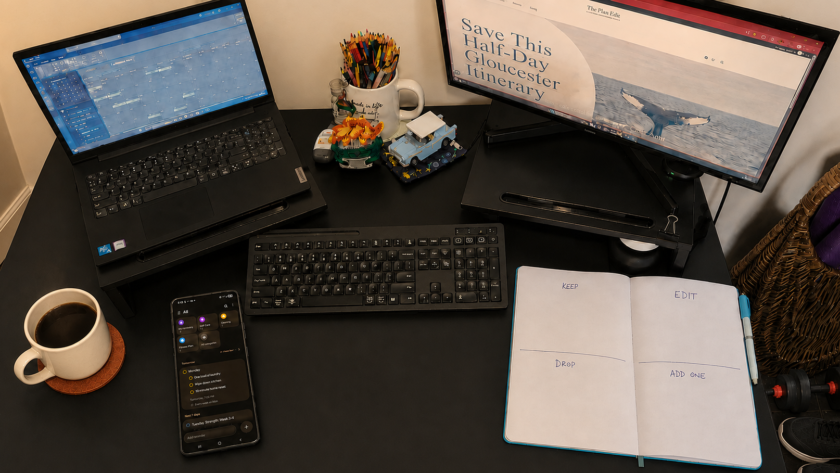
Use the Keep, Edit, Drop, Add One Method
Once you have chosen one routine, take out a notebook or open your Notes app and write four headings:
KEEP
EDIT
DROP
ADD ONE
Then answer one question under each heading.
Keep: What Is Already Helping?
A reset does not mean everything has to go.
What part of this routine already makes your day easier? What happens fairly consistently? What would you miss if you removed it?
Maybe your clothes are usually ready the night before. Maybe a recurring reminder keeps you from forgetting an important task. Maybe three planned workout days are more realistic than trying to exercise every day.
Keep the part that works. You do not need to rebuild it just because a new month started.
Edit: What No Longer Fits Your Real Schedule?
This is the part that needs adjusting, not abandoning.
Maybe the task still matters, but the time is wrong. Maybe the routine has too many steps. Maybe it assumes you will have more energy than you normally do. Maybe something that worked during summer no longer works with the school-year schedule.
An edit might mean moving a task, shortening it, changing the order, or creating a low-energy version.
A 30-minute workout could become a choice between 10, 15, or 30 minutes. Sunday meal prep could become a smaller Sunday setup plus a Wednesday refrigerator check. An hour-long evening reset could become ten focused minutes.
The routine is not a failure. It just needs to fit the life you are living now.
Drop: What Creates Pressure Without Meaningfully Helping?
Some steps stay on our lists because they sound responsible, not because they are actually useful.
What are you doing out of guilt, habit, or an unrealistic idea of how the routine should look? What do you repeatedly skip and then feel bad about? What takes more time than the result is worth?
You might drop the expectation that the kitchen has to be perfectly clean every night. You might stop forcing a full workout on an exhausted day. You might delete a reminder that has been overdue for three months instead of continuing to move it forward.
Dropping something is not giving up. Sometimes it is the edit that creates enough room for the important part to work.
Add One: What Is the Smallest Support the Week Needs?
The key word is one.
Do not finish this exercise with seven new habits. Add the smallest thing that would make the routine easier to begin or easier to repeat.
That might be putting your walking shoes beside your work bag, adding one emergency dinner to the freezer, setting a Friday money reminder, or placing a basket near the door for everything that has to leave the house tomorrow.
If the new support requires its own complicated system, it is probably too big.
What This Can Look Like in a Real Morning Routine
My Morning Power Hour is not the exact same checklist every day. Different responsibilities rotate through the week. Movement fits on certain mornings, hair care happens when it is due, and Friday is a better time for bills, banking, forms, school papers, and other adult life admin.
When something does not get done, I can move it into the next quiet morning instead of deciding that the whole routine failed.
If I used the four-question reset on that routine, it could look like this:
- Keep: The weekly rotation, because it prevents every morning from carrying every responsibility.
- Edit: Give movement a shorter option for low-energy mornings instead of treating 30 minutes as the only version that counts.
- Drop: The pressure to catch up on every missed task the same day.
- Add one: Put out the one thing I need for tomorrow’s focus before going to bed.
That is a reset, even though most of the routine stays exactly the same.
The purpose is not to win the morning. It is to protect a little time for the things that make the rest of the week feel lighter.
If your responsibilities are spread across the week too, the routine I use to keep a reset from becoming one giant Sunday checklist may help you build that rotation.
Not Sure Which Routine to Choose? Start Here
You only need to pick one of these areas this week. The rest can wait.
Movement
Keep the days that realistically fit your schedule. Edit the length so movement still counts when you do not have a full half hour. Drop the all-or-nothing rule. Add one easy cue, such as shoes near the door or a lunchtime walking reminder.
The goal is not an extreme September fitness challenge. It is to make movement easier to repeat in October.
Meals
Keep the foods your household already eats. Edit your prep so it supports the busiest parts of the week. Drop the complicated plan that depends on cooking a new meal every night. Add one or two emergency meals that require almost no decisions.
Instead of preparing a different complete meal for every night, I usually make two proteins and two carbohydrates that I can mix and match. One of those proteins is often cooked chicken breasts that I shred. The same chicken can become chicken salad, chicken tacos, or a simple protein with one of the sides I already prepared.
For carbohydrates, I might make white rice ahead of time and refrigerate it, bake sweet potatoes, or roast potatoes. Cooking the rice ahead fits the way I plan meals around my insulin resistance, and all three options are easy to pair with different proteins throughout the week.
I am not great at roasting vegetables without making them soggy, so I do not force that into my meal-prep plan. A salad is usually the more realistic option for me.
Sometimes I make a simple bean salad to add more fiber. I rinse one can each of red beans, black beans, and garbanzo beans, then mix them with chopped tomato and cucumber. A little vinegar, salt, and pepper turns it into an easy side that is already prepared when I build the rest of the meal.
Eggs and toast, frozen meatballs and pasta, or Greek yogurt and fruit also work when I need something simple.
The goal is not a refrigerator filled with perfectly portioned meals. It is having enough prepared pieces to build different meals without starting from zero every night.
Convenience food is not the enemy. Having no workable plan is usually the bigger issue.
Evenings
Keep the short task that makes tomorrow easier. Edit the reset to ten or fifteen minutes. Drop late-night productivity that steals sleep. Add one place near the door for bags, papers, keys, water bottles, or anything that needs to leave with you.
There should be a point when the day is done. You do not need to reorganize a closet at 9:30 p.m. to prove you had a productive Tuesday.
Money and Holiday Preparation
Keep a small weekly money check-in. Edit holiday spending so it matches the way you are actually paid. Drop obligations that do not fit your priorities. Add one repeatable payday action.
For me, that means starting Christmas shopping in August or September. I make a list of the children I am buying for, because I do not exchange gifts with the adults, and try to buy one gift or make similar progress each week when I am paid.
I do not need a separate Christmas sinking fund for that system to work. By spreading the purchases across regular paychecks, most of the shopping can be finished before December.
The system matters less than the result: December expenses should not arrive as a surprise.
Home and Winter Preparation
Keep the area that already functions well. Edit one problem zone instead of planning a whole-house declutter. Drop the idea that you need to sacrifice an entire weekend. Add one winter inventory before the first cold morning catches you off guard.
Start with the place that creates daily stress: the entryway, kitchen, bedroom chair, bathroom supplies, or car. Then check coats, boots, gloves, medicine, flashlights, batteries, and the car scraper before you urgently need them.
Knowing what is missing gives you time to watch for a sale instead of panic-buying it later.
Work, Digital Clutter, and Life Admin
Keep the list or reminder system you already check. Edit it into a few useful categories, such as Today, This Week, Waiting On, and Later. Drop old tasks that no longer matter. Add one ten-minute weekly review.
The Waiting On list is especially helpful at work. When you send something that requires another person to respond, put it there. Review it once or twice a week instead of carrying every open loop in your head.
Use the same rule for overdue phone reminders: do it, reschedule it to a realistic time, or delete it. An endless digital guilt pile is not a plan.
Test One Edit for Seven Days
Once you choose your edit, stop planning and try it.
Seven days is long enough to see how the change behaves during workdays, evenings, and a weekend, but short enough that it does not feel like a permanent commitment.
At the end of the week, ask:
- Did this make the routine easier to start?
- Did it reduce decisions, pressure, or last-minute scrambling?
- Did I repeat it more often than the old version?
- What still felt heavier than it needed to feel?
If the edit helped, keep it.
If it almost helped, adjust it again.
If it added more work than it removed, drop it.
The week gave you information. That is useful even when the first edit is not the final answer.
Your 10-Minute September Reset Checklist
If you want the shortest possible version, use this:
- Choose one routine that is making the week harder.
- Write Keep, Edit, Drop, and Add One.
- Answer each in one sentence.
- Circle one change to test.
- Set up the smallest thing you need to begin.
- Try it for seven days.
- Keep it, edit it again, or let it go.
That is enough for one September reset.
You can return to another area later, but do not turn this checklist into a new project that needs its own spreadsheet, shopping trip, and color-coded command center.
A Reset Is a Check-In, Not a Verdict
September can still be your second New Year. It can still be the month when you tighten up your routines, prepare for colder weather, and enter the final stretch of the year feeling more in control.
But locking in does not have to mean pushing harder in every area at once.
Sometimes it means noticing that a routine was built for an older version of your schedule. Sometimes it means shortening the plan. Sometimes it means removing one unnecessary step. Sometimes the most useful discovery is that what you are already doing works and does not need to change.
You do not need a brand-new life by October.
You need a few systems that make the life you already have easier to manage.
Choose one routine, make one edit, and let the next seven days give you information.